Stella McCartney’s Summer 2026 Collection: When Fashion Cleans the Air
For more than two decades, Stella McCartney has been fashion’s moral compass, proving that luxury can exist without compromise. Her Summer 2026 collection marks a turning point, one where design merges with scientific innovation to address climate change directly.
This season, McCartney presented garments that don’t just avoid harm — they actively contribute to environmental restoration. At the centre of this breakthrough is PURE.TECH, a textile coating capable of absorbing air pollutants. Alongside it, FEVVERS, a plant-based feather alternative, signals a new era for material ethics and luxury craftsmanship.

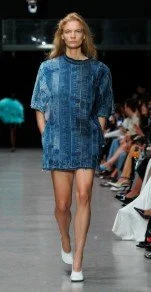
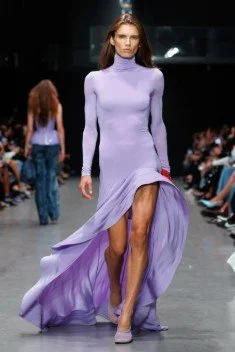
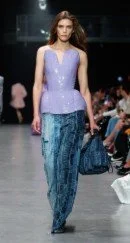
Air-Purifying Denim with PURE.TECH
McCartney’s collection featured denim treated with PURE.TECH, a coating developed through photocatalysis and catalysis processes to remove carbon dioxide, volatile organic compounds, and nitrogen oxides from the air.
According to Sustainability Magazine, the technology “can capture more than 2,000 ppm of CO₂ in 10 hours.” (Sustainability Magazine)
Manufacturing Digital notes that the innovation “transforms fabric into an active environmental tool, absorbing pollutants and converting them into harmless compounds.” (Manufacturing Digital)
FEVVERS: Plant-Based Feather Alternative
Alongside PURE.TECH, McCartney introduced FEVVERS, described by Vogue Business as “the world’s first plant-based feather substitute.” (Vogue Business)
The material was developed in collaboration with Chanakya International, a Mumbai-based atelier known for its ethical craftsmanship. The Guardian praised McCartney’s decision to replace animal-derived feathers entirely, calling it “a major cultural step for an industry long reliant on cruelty for beauty.” (The Guardian)
The Aesthetic: Minimalism Meets Biotechnology
Visually, the collection embodied McCartney’s understated precision — soft silhouettes, architectural tailoring, and fluid fabrics.
RAIN Magazine described the show as “a dialogue between masculine and feminine, grounded yet ethereal.” (RAIN Magazine)
The colour palette reflected air and light: pale greens, misty lilacs, and ivory tones that shifted as models moved, evoking a sense of breath and renewal.
Here, fashion was not merely decorative; it was performative — an act of environmental participation.
Fashion as Environmental Activism
McCartney’s latest work continues her mission to transform sustainability from a moral choice into a creative challenge.
Marie Claire UK wrote that the air-purifying fabric “marks a promising step toward environmentally conscious fashion by actively reversing pollution through wearable design.” (Marie Claire UK)
This collection repositions the role of the designer — from creator of garments to innovator of environmental systems. McCartney’s philosophy moves fashion beyond sustainability toward regeneration.
Beyond the Runway: The Future of Fashion Systems
The Summer 2026 collection offers a blueprint for the industry’s next chapter — where aesthetics meet material science, and garments become tools for change.
Supply Chain Digital called McCartney’s work “a bridge between luxury craftsmanship and climate technology, reshaping what material innovation can mean for high fashion.” (Supply Chain Digital)
McCartney’s long-term vision challenges other luxury houses to reconsider what progress looks like. Innovation, in her view, is no longer about speed or spectacle but about measurable impact.